
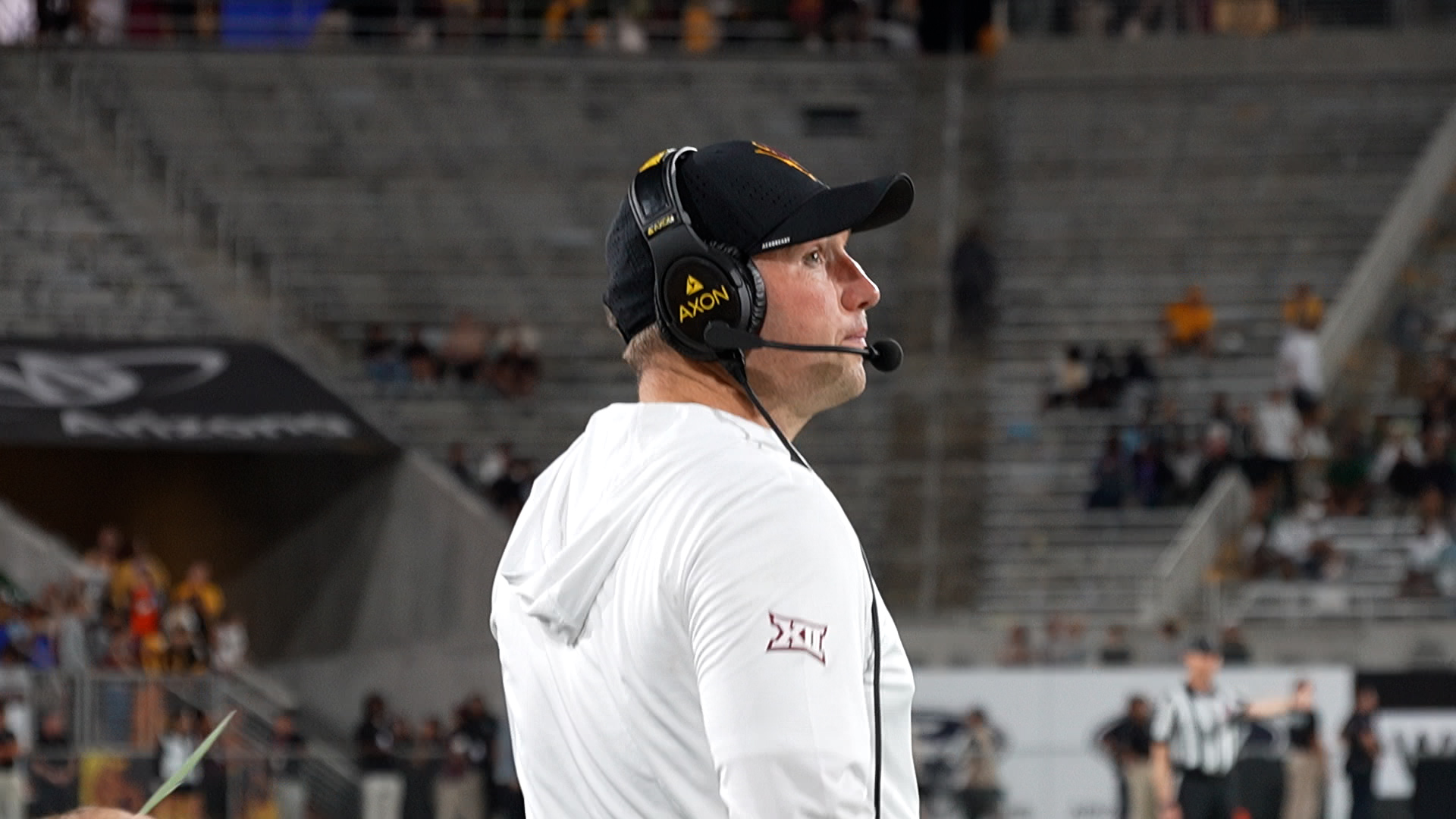
(Photo: Jakob Brooks/WCSN)
TEMPE — Many viewers understand the on‑field responsibilities of a head coach and quarterback. But in the social‑media era, both jobs come with something that unfolds outside the stadium: constant criticism.
Arizona State head coach Kenny Dillingham is consistently his own harshest critic, yet he’s shown a mostly apathetic attitude toward outside noise. After a crushing 55-19 loss to Baylor last week, however, he googled his own name in front of the locker room to show the negativity dominating discourse and how to block it out.
Dillingham’s changes didn’t stop there. During the week, he surrendered offensive play‑calling duties to offensive coordinator Marcus Arroyo. In some ways, that switch delivered positive results. But in others, plenty still fell short.
As for ASU third‑year quarterback Cutter Boley, it’s unclear where the online trend of fans labeling interceptions as sandwiches came from. But when a local restaurant named a cheeseburger after Boley, his interception against the Bears drew a predictable reaction.
Boley didn’t serve up anything burger‑worthy on Saturday night. But fans probably won’t be much kinder online toward him or Dillingham after the Sun Devils’ (3-2, 1-1 Big 12) closer‑than‑expected 30-12 win over Hawaii (1-5, 0-3 Mountain West).
“Fans are going to cheer and they’re going to boo,” Kenny Dillingham said. “That’s their job. That’s why it’s an awesome sport because there’s emotion involved.”
With ASU on fall break and many students away, Mountain America Stadium was noticeably less full. The stadium’s white seats showed even more in the second half as fans cleared out at halftime following a thunder delay that added 10 minutes to the game.
Those who stuck around made their frustrations known, particularly on a play with just under 11 minutes remaining. Facing a third‑and‑1 at the Rainbow Warriors’ 45‑yard line, sixth‑year running back Marquis Gillis ran directly into Hawaii’s nine‑man front. The result was a loss of two yards and boos aimed at Arroyo’s play call.
The Sun Devils entered the night converting just 29.6 percent of their third downs, worst in the Big 12. Saturday night’s 30 percent conversion rate showed a problem that persists no matter who’s calling plays.
“We got to convert those third downs,” Dillingham said. “That was the one thing on offense that we got to continue to get better at.”
Because ASU won the coin toss and elected to defer, its offense was up first after the delay. On the first play out of halftime, Boley ripped a throw that hit both of Miller’s hands. He couldn’t hold on, turning a would‑be first down into an incompletion. The Sun Devils proceeded to go three‑and‑out.
On the next drive, Boley placed a deep shot to second‑year receiver Raiden Vines‑Bright where only he could get it. But that pass was also dropped, and once again ASU’s offense ran just three plays. Boley threw for only 27 yards in the second half, a product of missed opportunities and the Sun Devils’ pivot toward a ground‑focused approach.
“We don’t want to go three and out twice,” Dillingham said. “We’d rather convert and then throw the ball more. That’d be awesome.”
Boley’s second half wasn’t spotless, with a few questionable reads and missed throws mixed in. It may be unfair, but every play from a quarterback — good or bad — is under a microscope. And one lowlight is often what fans choose to remember most.
His first half was strong, completing 15 of 20 passes for 162 yards and an opening-drive score. Arroyo’s early script didn’t differ much from Dillingham’s tendencies; it made fourth‑year receivers Reed Harris and Omarion Miller the passing attack’s focal points.
Boley’s first touchdown to Harris was something fans had seen plenty of times before. On a run-pass-option, Boley elected to throw, and he found Harris on a slant. Harris scored the game’s first and last touchdown, the latter coming on a screen pass inside the final two minutes.
“I think Reed’s confidence level is sky high,” Dillingham said. “There is no shaking of that confidence because of the level he’s playing at.”
Arroyo managing the offense allowed Dillingham to spend more time with the defense during practice and embrace a CEO‑style role, similar to how he operated last year before the Sun Bowl. In both of those areas, issues showed up.
It took less than 90 seconds for ASU to burn its first timeout of the game. The Rainbow Warriors’ field goal unit trotted onto the field, but the Sun Devils weren’t set to defend it.
Defensively, ASU was penalized five times for 56 yards, and three of those penalties came consecutively. Dillingham knows his players have to be more disciplined.
To fans, his constant preaching about the need for improvement can sound like a broken record, and he’s aware of that too.
“‘If we just keep getting better,’ it sounds so boring and monotonous,” Dillingham said. “‘What are you going to get better at? That hasn’t worked yet,’ what’s the other option? Try to get worse?”
For Dillingham and Boley, the scrutiny that comes with their roles isn’t going away. Saturday gave both of them moments that will be picked apart, from Boley’s uneven second half to the operational and discipline issues that fell on Dillingham.
With the non‑conference schedule now behind them and a trip to Lubbock next week to face No. 11 Texas Tech (5–0, 2–0 Big 12), the conversations around both will only grow louder.
“You can’t worry about the noise,” Dillingham said. “We’re in the grind of it now, seven straight conference games and it’s on. It starts this week versus an undefeated team.”

