
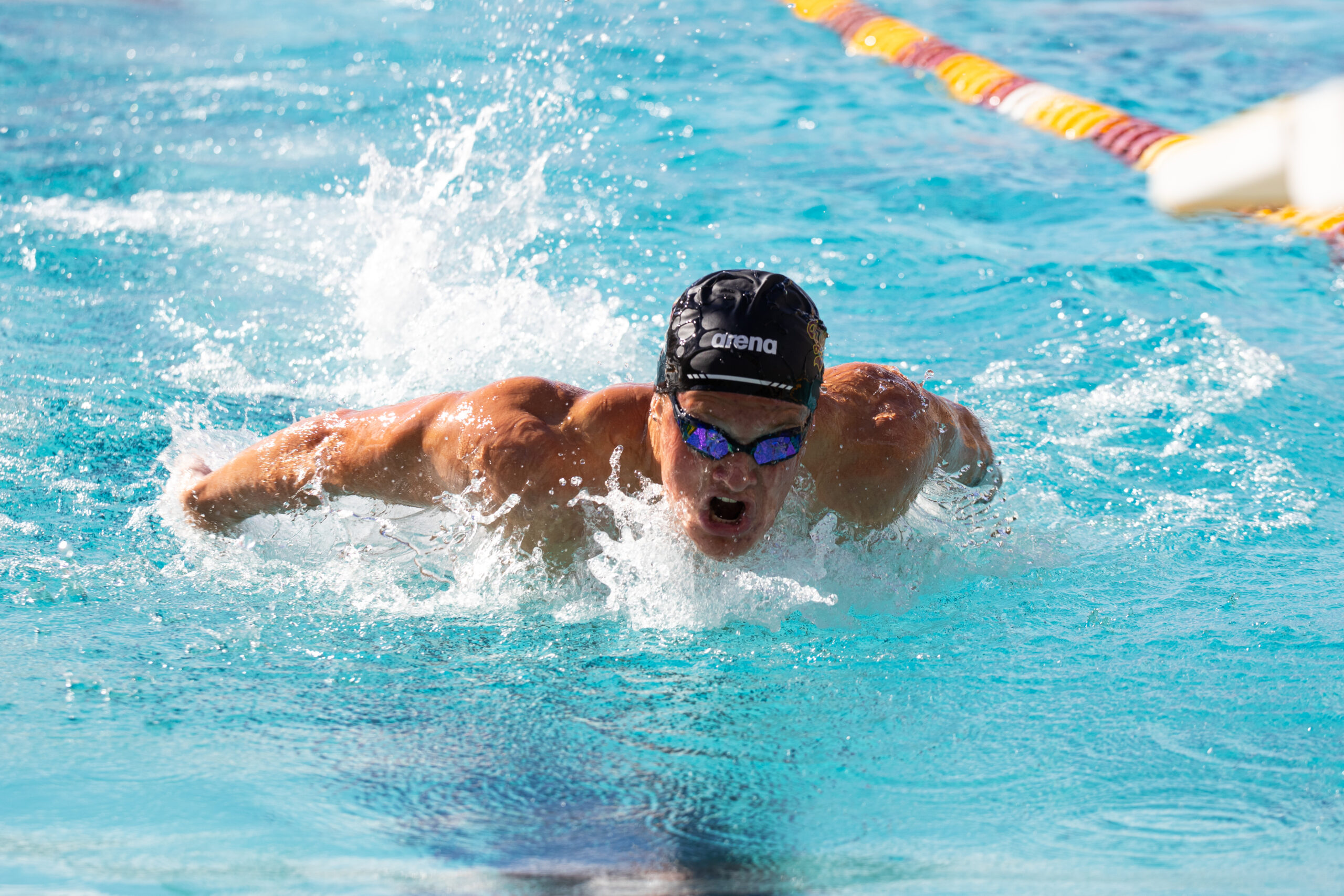
(Photo: Kaylee Wilkerson/WCSN)
Two days after the Arizona State men’s swimming team won its first national championship in 2024, head coach Bob Bowman told his associate head coach Herbie Behm at 9:30 a.m. that he was leaving the program for Texas. Two hours later, Behm was named head coach for the Sun Devils.
Behm has carved out a name for himself since stepping out of Bowman’s shadow, collecting back-to-back Big 12 titles and two consecutive top six finishes at the NCAA Swimming Championships.
The third-year head coach’s team has been undefeated this season, and so has Bowman’s as the Nos. 1 and 2 Longhorns aim for their third straight national championship. The two teams competed against each other and eight other programs at the Texas Hall of Fame Swimming Invite, held at the Lee & Joe Jamail Texas Swimming Center on Nov. 18-20.
But in the Nos. 5 and 16 Sun Devils first true test this season, they learned a lot about where they stand if they hope to return to the very same pool in March for the swimming championships.
Sun Devils’ men’s sprinters shine, but fall short in other strokes – Jamal Walker
The No. 5 Sun Devils brought the most men’s swimmers to compete at the Texas Invitational, and while the relay victories came as no surprise, it was the younger swimmers’ performances that showed how promising this team is and that their best times are yet to come.
ASU fourth-year Ilya Kharun took the top spot in the men’s 50-yard freestyle, touching the wall at 18.35 and behind him were his teammates, third-year Tolu Young and first-year Jake Lloyd, to complete the sweep for the Sun Devils in the fastest race on water.
Kharun sweeping the butterfly events wasn’t an option. The 50-yard butterfly wasn’t an event at this year’s invitational and the Olympian opted out of the 100-fly. But that didn’t stop him from making history. After posting an 18.68 50-yard split in the 200-yard medley relay, Kharun now holds nine of the 10 fastest 50-yard butterfly times in the world.
Another record-setting race that Kharun missed was one in which he set an NCAA record last season as a member of the men’s 400-yard freestyle relay. His presence in the water wasn’t necessary for the race as the Sun Devils took it at 2:46.20.
Behm still hasn’t found the lineup that he wants to run continuously through the season and went with two newcomers for the middle positions in the race: Lloyd and first-year Kristupas Trepocka. The lineup might still undergo further changes if the Sun Devils hope to reach a time close to the one they swam at the National Championships. Young opened the relays and third-year Quin Seider anchored the team with the fastest leg at 41.43. But the Longhorns showed they have a plethora of talented swimmers, taking second- and third-place finishes in the 400-relay.
The Sun Devils might have some of the best sprinters in the nation, but the Longhorns earned more victories outside of the freestyle stroke. Texas fourth-year Rex Maurer reminded everyone in attendance why he’s the 2026 NCAA 400-yard individual medley champion, improving his preliminary time by seven seconds at 3:37.75.
Maurer also anchored the Longhorns’ victory in the men’s 800-yard freestyle relay, but he had tough work to win the 500-yard freestyle. ASU second-year Noah Mudadu was 0.55 seconds away from Maurer as the two swam sub-25 seconds in the last 100 yards for one of the most exciting finishes of the meet.
Even when the Sun Devils were victorious, the Longhorns found a way to the podium to earn points for their team with the exception of the 200-yard backstroke. First Year Nathan Muratory swam a personal best (1:39.52) in the event beating his teammate, fifth-year Nick Simons while Northwestern third-year Oliver Kós kept Texas and Maurer off the podium.
The Longhorns couldn’t best the Sun Devils in freestyle relays or the 200-medley relay, but they were able to outswim them in the 400-yard medley. Even Kharun’s efforts in swimming the best butterfly split in the pool weren’t enough to get his team a first-place finish.
With Kharun limiting his load at the invitational, Seider carried the lion’s share of the work in the pool, competing in seven events for the Sun Devils and placing on the podium in six of them. Seider didn’t save his speed for the finals of the 100-yard freestyle. In the preliminary race, Seider swam 41.54, but later that day in the finals, he ousted his opponents in the water at 41.68.
Lloyd made the finals in seven events as well, but aside from placing in the 50-free, the newcomer showed that his times were worthy of being on every freestyle relay team.
ASU women struggle to match elite competition despite record-breaking performances – Hayden Hartigan
While the Sun Devil men collected seven event victories, the No. 16 ASU women faced tougher competition against the nation’s top programs at the Texas Invitational.
Despite breaking five school records over three days, ASU struggled to consistently place swimmers in championship finals, raising questions about the team’s depth against elite competition.
Second-year Albane Cachot led the Sun Devils, breaking the school and Big 12 records in the 50-yard freestyle with a third-place finish in 21.62 seconds. She also broke ASU’s six-year-old 200 freestyle record, finishing fourth in 1:43.27 as the only non-Texas swimmer in the top five.
Fourth-year Miriam Sheehan added two school records in Thursday’s preliminaries, swimming 51.05 in the 100 butterfly and 51.09 in the 100 backstroke. However, Sheehan finished fifth in both championship finals, clocking 51.38 and 51.70, respectively.
Third-year June Selin Tran-Hansen also earned a fifth-place finish in the 100 breaststroke (59.62), giving ASU another top-five individual performance.
The invitational showcased ASU’s top swimmers on the national stage while providing a measuring stick for a women’s program trying to match the success of its nationally accomplished men’s team.
The Sun Devils’ lack of depth was particularly evident Friday. ASU qualified just two swimmers for championship finals across five individual events. Cachot finished third in the 100 freestyle (47.18), while third-year Lucie Vasquez placed seventh in the 200 breaststroke (2:11.18).
ASU had no championship finalists in the 200 backstroke or 200 butterfly. First-year Alyssa Albertyn finished 10th in the backstroke (1:54.42), while third-year Julia Ullmann placed 12th in the butterfly (1:56.53).
Relays provided a bright spot for the Sun Devils in Austin with four top-three finishes. ASU’s 200 freestyle relay broke the school record with a second-place finish in 1:27.47, dropping 0.68 seconds and edging Stanford by just 0.01 seconds.
The 200 medley relay also showed improvement, dropping 0.74 seconds to finish second in 1:35.48. However, ASU added 1.69 seconds in the 400 medley relay, finishing fourth in 3:30.89.
The Sun Devils added a third-place finish in the 800 freestyle relay (7:01.50). Cachot, Albertyn, Sheehan and first-year Ellie Chalupsky capped the meet with another third-place finish in the 400 freestyle relay (3:11.58), the second-fastest time in program history.
Although ASU demonstrated its ability to produce record-breaking performances, the invitational highlighted the need for greater depth across individual events. With the postseason approaching, developing more championship-level contenders could be crucial to the Sun Devils’ title aspirations.
Early success partially a product of the schedule? – Xavier Massarotti
Ahead of ASU’s showing in Austin at the Texas Invitational, both the Sun Devil men’s and women’s swim and dive teams remained untested, not playing a top-15 opponent in the first month and a half of the season.
Now, against the back-to-back defending national champions on the men’s side and a top-three NCAA finisher for six straight seasons for the Longhorn women’s team, the story became different.
This meet will likely prove to be the hardest of the season for ASU, apart from a possible NCAA Tournament appearance.
On the pool deck, ASU won seven events for the Sun Devil men’s team and captured two top-three finishes on the women’s side which is a big accomplishment, given the strength of the meet.
Apart from the powerhouse of Texas, ASU competed against five other ranked opponents. As a result, seven of the ten teams in the invite came with a ranking associated with at least one of its teams.
With the meet over, a similar problem presents itself for the Sun Devils: The remaining schedule.
Last year in the pool, the Sun Devil men’s team swam against four ranked opponents and the women’s team faced off with six ranked opponents. This year, both ASU squads only have one currently ranked challenger left: the University of Arizona.
This raises the question of whether the Sun Devils will be battle-ready come the end of the season in a few months. On the one hand, the team could be less worn down because of the schedule, giving them a possible advantage health-wise. On the other hand, experiencing that competition against other great teams could only further elevate ASU’s play.
While this year’s schedule is a double-edged sword, the Sun Devils are still a talented team and the third-year head coach knows what it takes to succeed on the big stage as the both teams are the reigning back-to-back Big 12 champions.
As the season’s waves continue, ASU’s readiness for elite teams could stay unproven. Up next, the Sun Devils will race in the individual World Aquatics Swimming Championships from Dec. 1 to Dec. 5, before their next team meet on Jan. 9 against GCU back in the comforts of the desert.

