
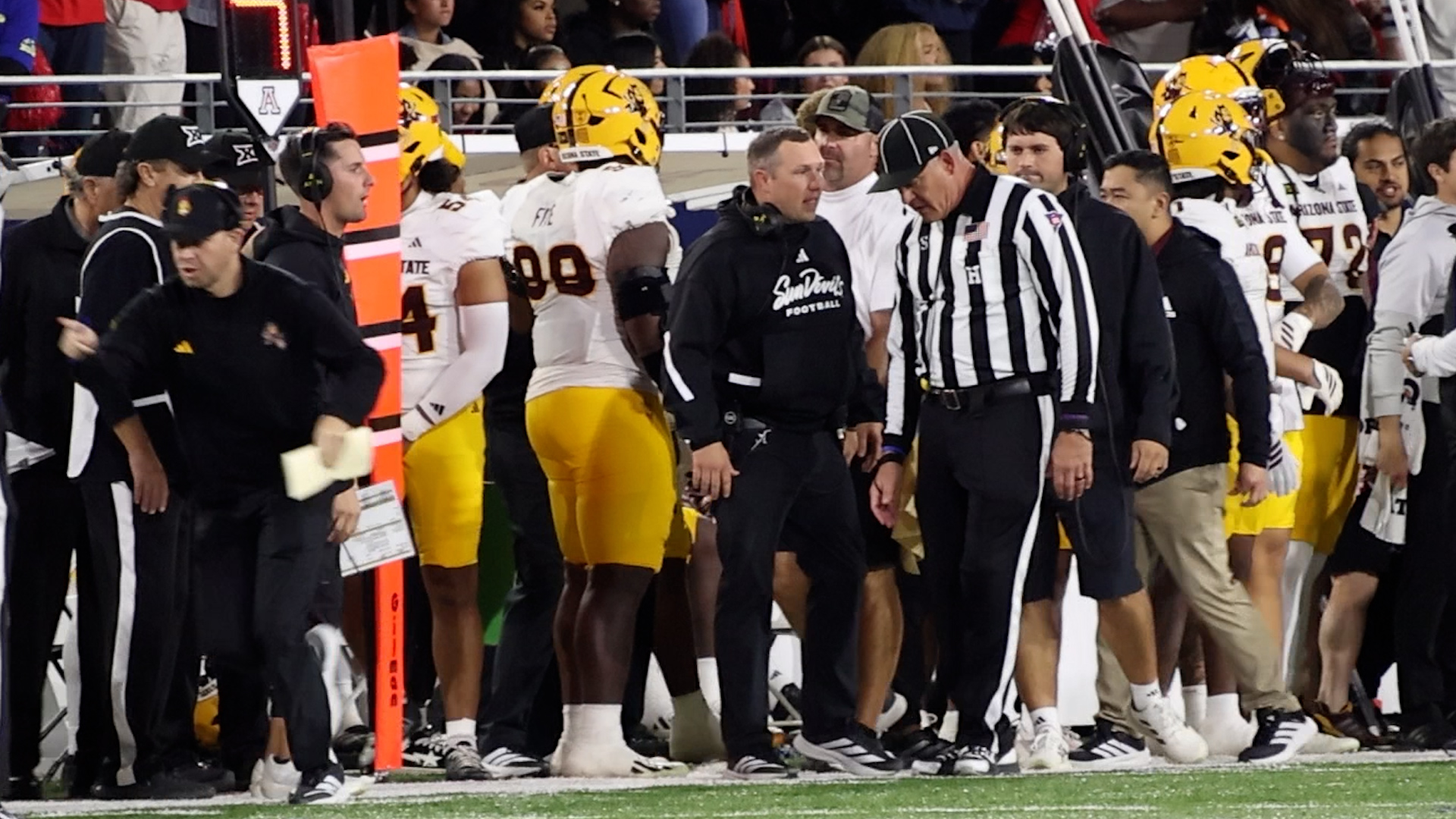
(Photo: Easton Stockford/WCSN)
TUCSON — The weight of failure lugged on Arizona State.
As the Sun Devils walked off the field, many couldn’t bring themselves to lift their heads. All they could see was a swarm of red shirts, mauling down the five-fingered signal meaning “Bear Down.” Disheartening to anyone donning the Maroon and Gold.
Assistant athletics director for player development DJ Foster, who played in four Duel in the Desert matchups finishing with a 3-1 record over the Wildcats, had tears visibly bubbling in his eyes. The former star running back stood there. No movement. Rather, he looked onto the field in deep reflection.
Head coach Kenny Dillingham felt the same way. Throughout his postgame press conference, the Sun Devils’ skipper could barely lift his eyes, only looking up to quickly engage with whoever asked a question.
While the Sun Devils’ (6-6, 4-5 Big 12) 42-21 loss to No. 16 Arizona (9-3, 6-3 Big 12) surely nagged at Dillingham, the bigger picture of an “average” season heightened his frustration — ending the season without the century-old trophy for the second straight season, and fourth time in five seasons.
“We got our butt kicked,” Dillingham said. “I’m proud of this team. I did not get this team to play to our potential. I did not manage the uniqueness of this season correctly. I have to take this season and learn from it and become better from it. They could have folded there in the middle of the year when we went on a three-game stretch when we weren’t playing well, and they kept fighting.”
Throughout the season, the Sun Devils looked like a team that couldn’t limit themselves to one mistake at a time. On Saturday, after playing to a manageable 14-7 first quarter deficit, the rollercoaster came crashing down.
With just over 12 minutes remaining in the second quarter, first-year quarterback Jake Fette took the snap and looked to hand the ball off to fellow first-year running back Cardae Mack. Instead of making a quick decision, the youngster waited. And waited.
When he finally made a decision, he pulled the ball out and fumbled, allowing Arizona to take the ball all the way back for a score. The ensuing possession saw the Sun Devils attempt a fake punt, leading to fourth-year punter Nick McLarty throwing a pick six, serving as the cactus-shaped dagger, like the one the Wildcats use to symbolize turnovers.
Against Texas Tech earlier this season, ASU seemed to have the Red Raiders dead-to-rights on an early fourth and one, deep in their own territory. The missed tackle sent Tech on a touchdown drive, immediately followed by a pick-six, putting a spear into the Sun Devils morale.
“We had that little dip in the season,” fifth-year defensive lineman Blazen Lono-Wong said. “You could tell everyone was kind of down a little bit, but everyone just kind of came together and realized that it is us. We have to be the ones to turn this thing around. We have to play for each other. It doesn’t matter how the season ends, as long as we play together, we play together, and we play hard.”
Between the lines, the Sun Devils never seemed to find a consistent offensive rhythm. ASU scored over 30 points just twice, in games against FCS opponent Morgan State and Group of six Hawaii—finishing the season 14th in the conference in points per game with 27.5.
On third down, the Sun Devils finished the regular season dead last in the conference, converting on just 31.5% of attempts. Combine that with the second-worst red zone offense (81.5%), and the Sun Devils were rarely able to muster enough points to win quality games, leaving the offense in need of modification.
“We haven’t been good enough on offense,” Dillingham said. “All that eventually falls on me. Obviously there’s a lot of things that we could have been better at, specifically offensively, that we have to address immediately, starting tomorrow. We have to address those things.”
Before the Sun Devils’ appearance in last season’s Sun Bowl, Dillingham decided to take the play-calling duties from offensive coordinator Marcus Arroyo, a role that he utilized at Oregon to propel himself as the head coach of his Alma Mater. Despite losing the ability to call plays, Arroyo remained with the Sun Devils in 2026.
After the Sun Devils 55-19 loss to Baylor, Dillingham relinquished play-calling, feeling he lost his ability to connect with the team as a whole. While ASU’s overall team performance eventually improved, the offense stagnated.
“I shouldn’t call plays,” Dillingham said. “I shouldn’t do that. It took our team a while to get back into the mindset. My role here is not to call plays. My role here is to be a head coach and then do whatever I can to help the offense and the defense just play better. That decision I made, going back to last year to do that, I think it’s had a negative effect on the team this year.”
In 2025, following the 2024 Big 12 Championship win and College Football Playoff appearance, Dillingham didn’t have to make many roster moves. His core group of players from that team, including former quarterback Sam Leavitt and wide receiver Jordyn Tyson, all returned.
This season, ASU was out of luck.
With Leavitt’s transfer to LSU, Tyson’s exit to the NFL and the loss of a plethora of other pieces to graduation, Dillingham’s hand was forced. The new transfer class featured three key offensive weapons in second-year quarterback Cutter Boley, fourth-year wide receiver Omarion Miller and fourth-year wide receiver Reed Harris.
While Harris found clear success in Tempe, with a 1332 yard and 13-touchdown season propelling him into first-round NFL Draft conversations, the other two failed to establish consistent roles. Miller showed flashes of the hype he carried, but never became the true No. 2 option.
Boley, on the other hand, proved to be Dillingham’s biggest whiff. After throwing for six touchdowns in the opener against Morgan State, Boley lost his way, eventually being benched in favor of fifth-year quarterback Mikey Keene. Following Keene’s injury against Kansas State, Boley’s play forced the Sun Devils into an unexpected scenario: starting a true freshman quarterback.
Though Fette’s performance proved worthy enough to leave him as the starter, his increased role was still a surprise nonetheless.
“There’s some things you can’t fix mid-season,” Dillingham said. “There’s some things that, if they happen, there’s no fix. Doesn’t matter. You can’t wave a magic wand. You just have to find a way to try to be good without it, or good in spite of it, and the goal is to not be put in those situations.”
Dillingham has often praised the newfound “high standard” that his previous teams, particularly in 2024 and 2025, set. However, despite showings of positivity from the young talent, the 2026 Sun Devils never seemed to do anything outside of the expectations. From that, Dillingham and the Sun Devils will now get an entire offseason to attempt to return to the form that Sun Devil fans had grown accustomed to.
“I’m not concerned about the program,” Dillingham said. “I didn’t do a good job coaching the team. I could have been better at coaching the team, but I have zero concern about the football program. I’m not concerned about the program. I’m actually excited about the program. I’m frustrated with how I was a head coach for this team.”

