
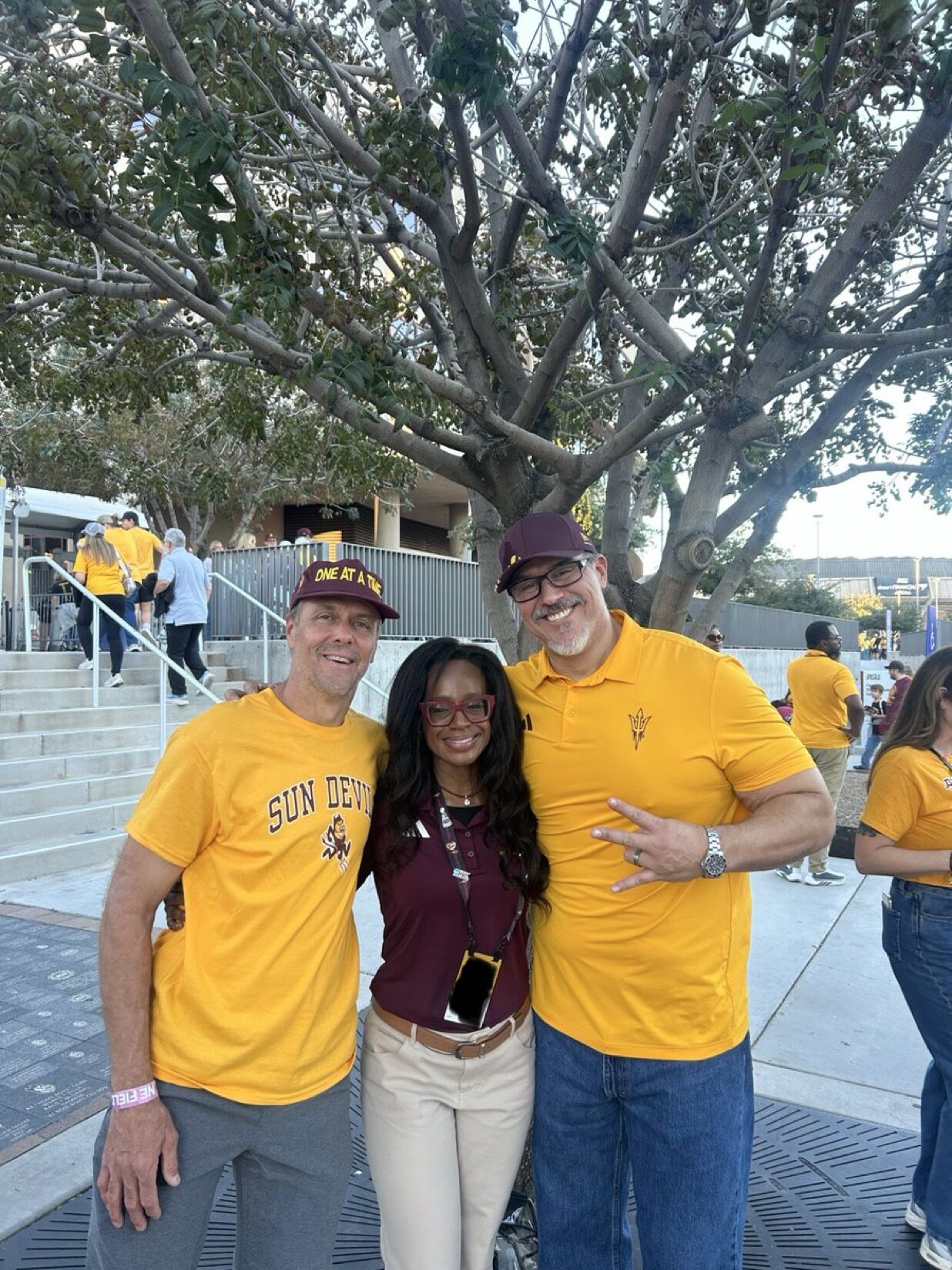
(Photo: Courtesy of Rhonda Clark)
Saturdays in Tempe.
Arizona State fans drive in from all over the valley to watch the Sun Devils compete. Sprinkled throughout parking lots and garages, a motley of supporters, decked out in maroon and gold, set up tents, grills and coolers in preparation.
After eating delicious food and enjoying drinks with friends, it’s time to head to the stadium.
As fans walk through security and toward the Southwest entrance of Mountain America Stadium, Rhonda Clark, a guest services representative, greets them with a smile. She tries to interact with every fan who comes to scan their ticket in her lane—trying to ensure that every single person feels at home.
Little did those fans know, ASU has become more than just a home for Clark.
ASU’s been there for some hard times for me,” Clark said. “I love the university. I love what it stands for with the inclusion of everyone.”
Growing up, attending college football games was the furthest thing from Clark’s mind. In parts of her childhood, she was without a home. It wasn’t just a lack of community; she was homeless.
When she got to high school, a man named Irvin Coin took her under his wing and introduced her to Upward Bound, a program that helps first-generation college students in underprivileged communities prepare to pursue secondary education. As part of the program, students are able to work with mentors and enroll in college-level classes, with the hope of getting a head start.
“Once I started taking this program, it teaches you about yourself, your abilities, your strengths, weaknesses, opportunities that you have,” Clark said. “They provided scholarships for kids like me to attend ASU. Once I got into that program, every Saturday we would take classes, and we’d have homework on top of our high school homework. Then in the summers we would take actual college classes. And I think just through that experience, I decided that yes, I want to go to college.”
Taking classes on campus at ASU allowed Clark to skip the nerves that come with picking a college and deciding a future. Instead, she carried the weight of her past and utilized the opportunities provided by Upward Bound to enroll as a Chemistry major in 1987.
“I had gotten used to the ASU atmosphere, “ Clark said. “I thought, ‘Well, this is a great place to go.’ So in my mind, I knew I was going to go to ASU. I didn’t know how I was going to get there because I had no money. Thank God, through scholarships and things, I was able to attend, but I just liked the atmosphere, the weather, the fan base, everything.”
Eventually, Clark decided to get her doctorate in Pharmacy from the University of Arizona — though she claims she is still a Sun Devil through and through — giving her the nickname “Dr. Sun Devil”. Since then, Clark has worked in hospitals as a clinical pharmacist for over 30 years, helping people in need.
“The more that I talk to other people, (Upward Bound) is actually a national program for students like myself who might not have had the resources to go to college,” Clark said. “To consider college, to improve their lives or open up the possibilities of what they could achieve, and through that, I found ASU.”
Taking classes and simply being on campus introduced Clark to another crucial part of Sun Devil culture: football. When Clark arrived in Tempe in 1987, the Sun Devils had just won the Rose Bowl over Michigan, making season-student tickets a sought-after prize. Lines formed all the way around then-called Sun Devil Stadium.
Unfortunately for Clark, she didn’t get the tickets.
Still, she found a way to attend as many of the games as possible. It was a reality that seemed out of reach years earlier.
Through her experiences, Clark found her people. People to hang out with, tailgate with, and most importantly, people who loved watching ASU football. Those early relationships became the stepping stones on her path to becoming a superfan.
“I like the atmosphere,” Clark said. “I like belonging to something I never belonged to before, so this was something where I could meet people, we could have a common love or interest, and be excited about a team.”
Within that community, Clark found one of, if not the most important people in her life: her husband. Clark said that one of the first things that they bonded over was ASU sports, helping shape their family and relationship for life.
Even one of her sons got his name from a trip that the couple took to support ASU. In October 2003, the Sun Devils, led by then-head coach Dirk Koetter, flew over to Chapel Hill, North Carolina to play the Tar Heels. As part of the trip, Clark and her husband toured Cameron Indoor Arena at Duke University.
After the trip, the pair named their son Cameron. A fitting nod.
“He and I are both graduates from Arizona State,” Clark said. “When I met him, he was huge into Arizona State athletics. So was I. We just started going to the games together, and then when we started having kids, we started traveling together. We travel for football. Mostly it was football, but then it expanded to basketball.”
So far this season, Dr. Sun Devil and her husband have traveled to College Station, Texas, and to London to cheer on the Sun Devils, and plan to go 110 miles down south to watch the Territorial Cup.
“When football season’s here, we don’t go on dates,” Clark said. “The football game is the date. So I know not to ask, ‘What are we gonna do for Saturday?’ We’re going to the game.”
Nowadays, Clark is almost a celebrity around Tempe, constantly snagging photos with prominent Sun Devil figures such as play-by-play broadcaster Tim Healey, ASU baseball head coach Willie Bloomquist and others. Perhaps her most famous photo is with former Sun Devil quarterback Jake Plummer.
During ASU’s November 7 game against Colorado, members of the 1996 Rose Bowl team were honored on the field. As Plummer and former offensive lineman Juan Roque were walking into the stadium, they stopped. The pair approached Clark and asked to take a photo, which she giddily accepted.
“It all goes full circle because when they were playing, I was out of graduate school,” Clark said. “I was watching them play, and that was a magical season, of course. So I gave them a million hugs and thanked them, and it was just really cool. Who else is going to have this picture? I can tell you, no one, no one’s going to have this picture, and it was so cool.”
Following her shift, Clark tweeted the photo, saying how excited she was to get stopped by two Sun Devil legends. Her story clearly resonated with Plummer, with the Sun Devil legend tweeting back, “Cause you’re a legend!!!”.
“There were just so many neat people that I met throughout the years that had the same passion,” Clark said. “To be a part of a school that has a football program, you’re either a real fan or you’re not. Because there were years where we didn’t perform well, but we still attended every game. And then when it expanded to traveling to other cities, even other countries, it just kind of furthered my love for Arizona State University.”
Also embodying Clark’s ability to be herself among the Sun Devil community she loves is another superfan, who roamed campus about 30 years after she did. Obafemi Oso began as a student in the early 2010s, and quickly became an on-campus celebrity.
In 2012, Oso also made the trip down south to watch the Duel in the Desert. Rather than sit with the Sun Devil faithful in the corner of the end zone, Oso immersed himself in the full experience of the rivalry, parking himself in the front row of the Zona Zoo — Arizona’s student section.
“I had a sister who was there,” Oso said. “I didn’t ask her first, but I did my research and found out that the U of A Zona Zoo is open to the public two weeks prior to the game. I said, ‘Hmm, I’m the public. I qualify for that.’ So I waited until two weeks prior to the game, bought myself a ticket, and it’s general seating through the whole deal.”
As the Sun Devils erased a 10-point deficit in the fourth quarter, led by Oso’s friend, running back Cameron Marshall, who scored the go-ahead touchdown late, Oso did what he always did: be himself. With his bare chest reading ASU and a pitchfork painted just below, Oso raised his hands in the shape of the ASU Pitchfork and just screamed three simple words.
“Let’s go, Devils!”
ESPN cameras even caught this moment on the broadcast, catapulting him to Sun Devil stardom. It was clear that he was just being himself—something that resonated with fans throughout Tempe.
His wild high-top hair, first-row student section spot, and lack of care for what anyone else thought allowed him to become the 2010s-era superfan, even earning him an appearance on the jumbotron for “Sun Devil Story”, a weekly segment in which fans share their connection to ASU.
“I really think that what attracted people to me and my representation as a fan was that it was evident that I wasn’t doing it for a performance,” Oso said. “I was doing it for myself. That invited everybody else to, for themselves, also be like, ‘Oh, I can be a goofball.’ I can have a ton of fun screaming for you know some boys playing football for a university that I love. My alma mater or whatever that might be, whatever your situation is, but it is allowed. I think it inspired people in that way.”
Whether it is Obefemi or anyone else in the stands, all Sun Devil fans can stand to learn a thing or two about the community at ASU and people like Clark—one that allows people to be themselves and turn that into passion for not only the athletic teams around Tempe, but also for the people that support and work for them. Clark said she plans to continue spreading her experience as a super fan to help others find that same community.
“There’s a couple of people that I know that are well known,” Clark said. “I just always give him a hug, encourage them, and take pictures with them. I say, ‘Hey, another legend.’ They’re like, ‘No, I’m not a legend.’ Yes, you are because I know a lot of people watch you. So I’m all for supporting other superfans.”

