
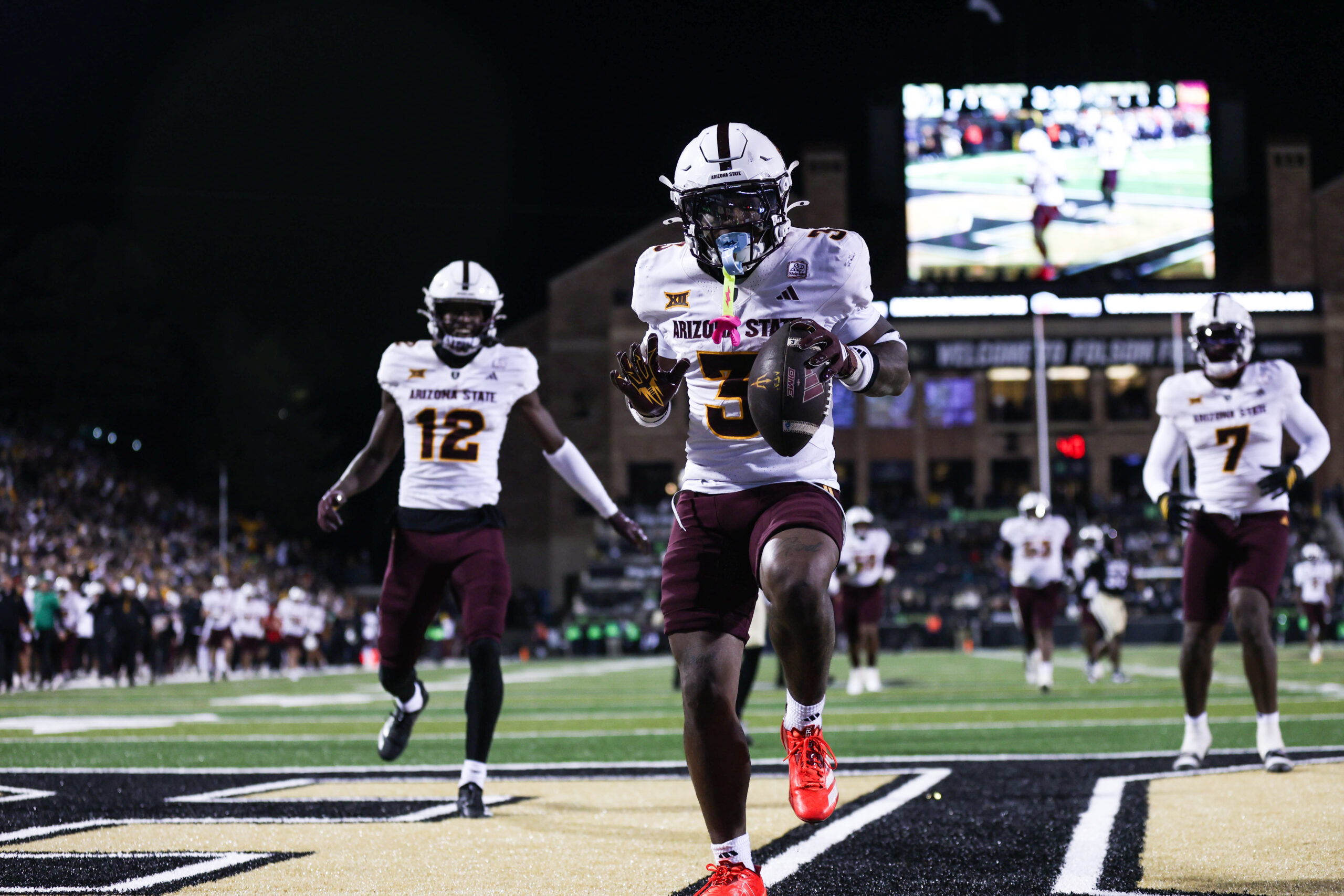
(Photo: Marina Williams/ WCSN)
Arizona Proposition 200 was approved on Nov. 4, 1958, as nearly two‑thirds of voters circled “yes” at the ballot box. The citizen-initiated statute sought to change Arizona State College’s official name to Arizona State University.
Since that vote, No. 20 Arizona State football (8-3, 6-2 Big 12) has posted a 37‑28‑1 record against No. 25 Arizona (8-3, 5-3 Big 12) in the Territorial Cup, including a 18‑14‑1 advantage at home. Friday night’s duel in Tempe will mark the 99th chapter in this storied rivalry, as ASU is aiming to retain college football’s oldest rivalry trophy.
It has been nearly 126 years since the first meeting between the two schools, but one season holds particular relevance to Friday’s game: 2014. For the first time since, both the Sun Devils and the Wildcats will enter the night as ranked teams. That season also marked Kenny Dillingham’s first college coaching job, serving as an offensive assistant for ASU — the program he now leads.
“It is cool for the state to have two really good football programs,” Dillingham said. “It is awesome for the fans, the environment and the narrative.”
Between 2023 and 2024, the rivalry reversed as the Sun Devils and Arizona exchanged both game outcomes and season records. Kenny Dillingham’s debut season closed with a 59‑23 loss to the Wildcats. This was ASU’s ninth defeat and Arizona’s ninth victory. To conclude 2024, the Sun Devils flipped the script and stormed to their 10th victory with a 49‑7 rout, handing the Wildcats their eighth and final defeat.
Heading into Friday, the record disparity is gone, with both teams sitting at eight wins. Arizona’s 2025 season has shown improvement on both sides of the ball, particularly on offensive. After a standout campaign in 2023, redshirt junior quarterback Noah Fifita’s performance took a step back in 2024, his passer rating falling from 165.9 to 126.5.
This season, his passer rating has climbed back to 151.9, and his touchdown rate has returned to 2023 form, improving from 4.2 to 7.4 — nearly matching the 7.5 mark he set that year. As a team, the Wildcats are scoring 33.5 points per game this season, up from 21.8 a year ago. The offensive uptick is all the more notable considering Arizona lost receiver Tetairoa McMillan to the NFL last April, after he piled up 2,721 yards and 18 scores across the 2023 and 2024 seasons.
“Noah’s playing as good as any quarterback in the country right now,” Dillingham said. “(The Wildcats) saw an outlier in last year, and then they’re back to where they were.”
On defense, Arizona is allowing, on average, one fewer touchdown per game this season, with the unit’s points allowed dropping from 26.9 to 20. According to Pro Football Focus (PFF), a company that evaluates each player based on film review, 10 of the Wildcats’ 11 defensive starters earned grades above 60, a number viewed as average caliber. [link: https://www.pff.com/ncaa/scores/2025/14/arizona-wildcats_at_arizona-state-sun-devils_29554#lineups]
Arizona could also see a key boost in the secondary with redshirt junior cornerback Jay’Vion Cole, who missed last week’s game due to injury but is listed as questionable. His presence would be impactful as PFF lists him as the third‑highest graded Wildcat on defense with an 81.6 grade.
Arizona’s strength on defense is its back end, with four defensive backs graded above 75 including Cole. One of those four secondary bodies is junior free safety Genesis Smith, whom Dillingham has described as “the most valuable player in their defense.”
Another safety, redshirt senior Dalton Johnson, is coming off an 18‑tackle performance that earned him Big 12 Player of the Week honors — the most by a Wildcat in a single game since 2014, a year that already looms large in the context of Friday’s matchup.
“That back end is playing as good as literally any back end in the country,” Dillingham said. “Probably the best secondary we’ve played all year.”
Anchored by a ball‑hawking secondary, Arizona is averaging 2.1 turnovers forced per game. Since redshirt senior quarterback Jeff Sims was thrust into the starting role earlier in November, ASU’s offense has given the ball away eight times in its last three contests.
Ball security will have to be a point of emphasis for the Sun Devils on Friday. Even though the record is 3‑0 over that stretch, winning while turning the ball over at that rate is simply unsustainable.
“We’re not playing good on offense. Point blank. The offense has been a disappointment this year for the most part,” Dillingham said. “It hasn’t been firing on all cylinders for one way or another. We just haven’t clicked.”
Nearly seven decades after Proposition 200 cemented ASU’s name, the Territorial Cup remains a fight for bragging rights in the state of Arizona. First contested in 1899, when ASU was known as Tempe Normal School of Arizona, the rivalry has grown into one of college football’s most enduring traditions.
With both schools ranked for the first time since 2014, Friday night carries echoes of history and the weight of legacy. For Dillingham, the Territorial Cup isn’t just about records or rankings. He compared it to memories of playing against his own brother — a battle where the outcome lingers in his head all year long.
“You always want to beat your brother the best when you play your brother in something,” Dillingham said. “I play a random person, that sucks for a week, right? But you play your brother, and you’re around them 24/7, you hear it all year and it’s horrible.”

