
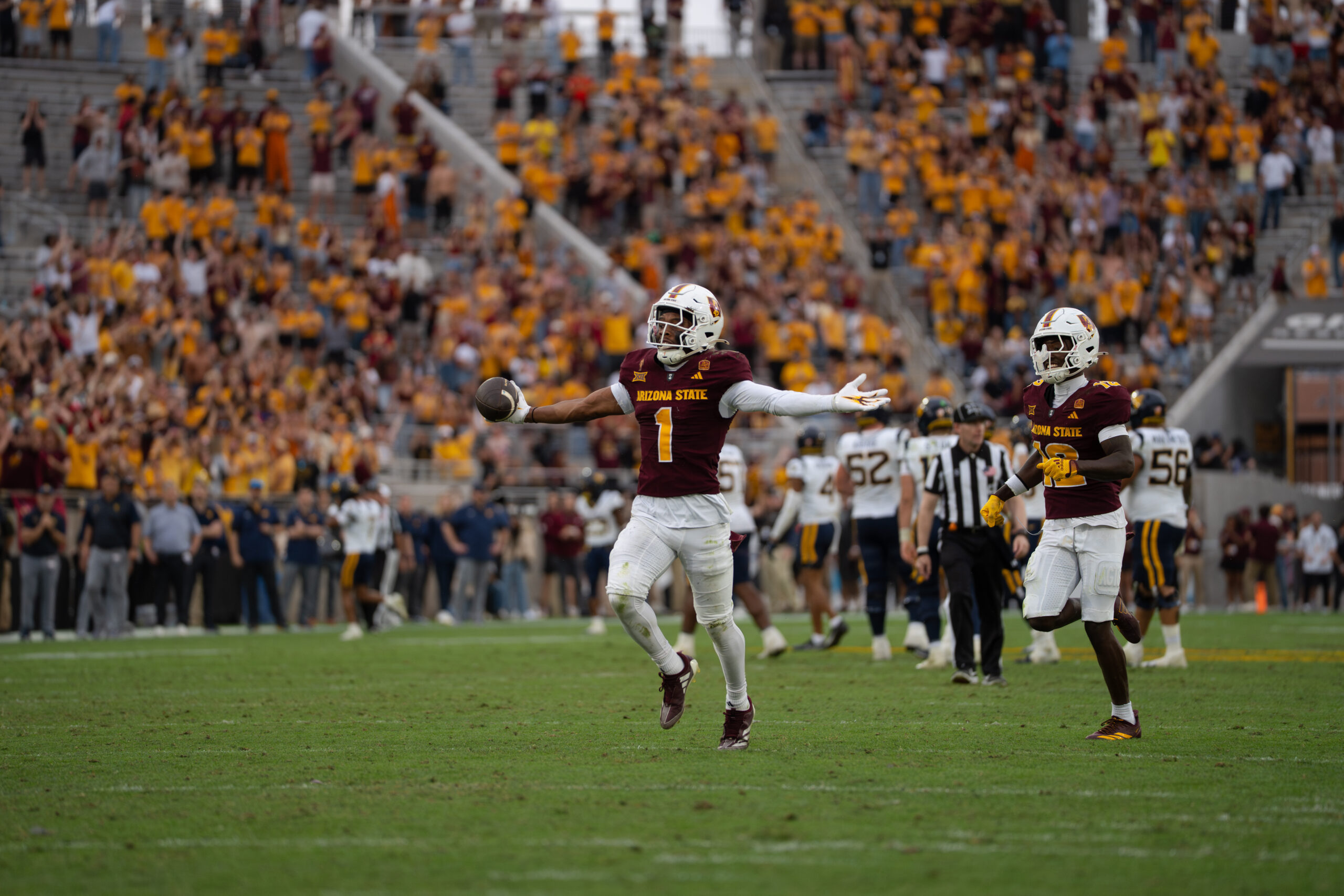
(Photo: Jack Simon/ WCSN)
The crowd broke out in cheers for Arizona State junior defensive back Keith Abney II. It wasn’t the first or the last time they would do so for him, mesmerized by his athletic feats.
Abney, however, wasn’t playing on the manicured Bermuda grass of Frank Kush Field, surrounded by a sea of maroon and gold filling Mountain America Stadium’s stands to the brim. He wasn’t even enrolled in ASU.
He was on the hardwood of the Speedway Sports Complex in Lincoln, Nebraska; he was only in seventh grade, and he wasn’t wearing cleats. Instead, his feet were fitted to a pair of inline speed skates.
To the wearer, they were as natural as walking shoes.
Abney showed off his mastery, flying down the straights and smoothly slicing his way around the corners as he pulled ahead of his competition at the 2017 USA Roller Sports National Championships. When he crossed the finish line in 27.64 seconds, he didn’t just win the race; he smashed the 13-year-old, 300-meter indoor national record.
It was undoubtedly a great accomplishment, but it also wasn’t anything new.
“It was (the) fourth or fifth (record),” Abney said. “It was probably my favorite one, though. That was a great race.”
Long before Abney became one of Pro Football Focus’s top-10 cornerback draft prospects for 2026, he was a force for the DFW Speed Skating Team while growing up in the suburbs of Dallas. After his skills were recognized, winning became second nature. He always had the hunger to be great and the talent to make that goal a reality. Under the tutelage of his coaches, an attempt at Olympic future wasn’t even out of the question.
“It is crazy, a little bit,” Abney said, reflecting on his background after one of ASU’s recent practices. “I didn’t realize how unique it was until the guys (were) like, ‘Dang, you can skate that fast? You’re like Frozone.’”
It’s not unusual for Division I football players to have grown up playing two or more sports. However, most of the time, they’re more popular pastimes like baseball or basketball.
While Abney played those sports growing up as well, skating also made perfect sense for him.
Abney’s grandmother, Brenda Ratcliff, operates Ratcliff Learning Center, a daycare in the greater Dallas area that has been taking kids to Redbird Skateland in Duncanville, Texas, since before he was born.
When Abney was 2 years old, he started tagging along to explore a fun, new hobby.
Like most beginners, Abney – who had acquired the nickname “Baby Keith” at the rink thanks to his size and age – started on four-wheeled quad skates, but his time on them didn’t last long. He was quickly drawn to faster, more challenging inline skates.
He lacked a level of finesse out of the gate, but overall nailed the transition to the trickier skates, which demand greater ankle control. Soon, he was winning races at the rink by half a lap, and Gil Hudson, the owner of Redbird Skateland, realized how special Abney could be on wheels.
“It was like he was born on skates,” Hudson said. “He was fun to watch because he would just run on the skates. … That’s how I found out that he was really fast, because when you’re using inline skates, if you’re actually running on them, almost like you’re running on your shoes, instead of stroking like a speed skater would stroke, then you’re wanting to go even faster than they will allow you to go.”
Hudson, self-admittedly, isn’t too tapped in with the speed skating world, but his son Chad had participated in the sport as a kid. That background gave Hudson enough knowledge to see Abney’s potential and make a referral.
The skating rink owner reached out to Chad’s old coach, Ricky Brock, a former national placement with 25 years of skating experience, before he turned to teaching, to tell him about his discovery, while encouraging Abney’s mom, Tammi, to take her son to him.
“I said, ‘You’ve got to get this kid in front of Ricky Brock and let him look at (Keith), and see if (Keith) likes skating like he does here, then I think that he could really do something,” Hudson said.
And so Abney, at just five years old and equipped with little more than raw talent and exuberance, left the comfort of Redbird Skateland for the unknown of Ricky Brock and his DFW Speed Skating Team in Arlington.
“A little kid came in with what we call Big Bird skates,” Brock said. “They’re bright yellow rental skates, and Gil had told me he was coming, but he would want to skate on his rental skates. Gil actually gave him those rental skates to come to practice, and the kid was amazing.”
Abney’s obvious talents shone through the lackluster equipment, and Brock brought him aboard the team, where he and the late Todd Hackney would go on to train Abney and enter him into competitions.
Brock knew, though, that he was going to have to get his new protégé out of his Big Bird skates and into competition-ready equipment.
Tammi Abney and Hudson had already tried to get Keith to move from the Big Bird skates into ones with lighter, aluminum frames and bigger wheels. However, the young athlete wasn’t impressed with the aesthetic qualities of his other options.
“They look cool, and it was yellow,” he said simply, reflecting on his fondness for the Big Bird’s.
Abney’s natural talents made the Big Bird’s look like a yellow blur. He might’ve been able to skate circles around friends at Redbird Skateland, but they limited his potential. When he realized he was going to have to switch to have a chance to be as fast as the older, bigger kids, he didn’t look back.
Within half a year with proper skates and training under Brock and Hackney, Abney made it to the South Central Regionals, competing against other kids from Texas, New Mexico, Arkansas and Louisiana, all vying for a chance to go to nationals.
It was Abney’s first true test, and he passed with flying colors, making the cut.
His first time on the national stage didn’t end in gold, but it further convinced Brock that the young skater had what it took to be special.
“The kid (had) amazing focus,” Brock said. “Everybody else was looking at butterflies, and he was focused straight down (at) the floor, waiting for the gun to fire. I looked at his mom, said, ‘I’ve coached many, many kids, but I’ve never seen a kid with his focus.’ And he remained that way from that time I started him to the time he left.”
Abney’s focus and determination quickly led to a work ethic that’s paid off, not just in his career as a speed skater, but also in his time as a Division I football player.
Tuesday and Thursday nights after football practice during the school year were dedicated to training with DFW Speed on indoor short tracks. During the summer, as he grew older, he started skating on outdoor tracks like the ones used in international competitions. Even on days when there weren’t practices scheduled, Abney would still get work in with his mom.
Weekends were reserved for meets, where skaters were split into divisions based on age, and their placements in races of varying lengths were averaged into a points system that determined results.
According to KeithAbney.com, which gives a time capsule-esque view into his accolades up to the age of 11, it didn’t take long for him to start stacking success. He won his first national championship in 2014 when he was 9 years old, and broke his first records, including the 200-meter national record, a year later, when he was crowned both the indoor and outdoor national champion.
“You train and you go to practice,” Abney said. “Then you finally go to a meet, and you’re competing against guys from all across the country, and you’re just dominating and winning and setting records. It was kind of cool just seeing the whole process.”
Abney wasn’t content, though. It wasn’t enough to be the fastest kid his age; he wanted to be as fast as the older kids. It was part of his competitive nature.
“Knowing what it felt like to not be that fast, and knowing the work that it took, it kept me level-headed,” Abney said.
One day, in the midst of his success between 10 and 11 years old, Brock found him sitting by the snack bar between his practice sessions, watching a group of older skaters, including 18-year-old Team USA member Michael Ringer, fly around the track.
As Ringer and the group continued to show off their speed, Abney looked down at his skates and rolled the wheels before asking an apt question: “Same skates they’ve got. Why aren’t you as fast as they are?”
Of course, Abney was considerably younger, but he wouldn’t have cared for that excuse.
“I just wanted to be as fast as them,” Abney said. “It was like, ‘Dang, how do I get there?’ Coach was just saying, ‘Just keep coming to practice, it’s going to take time.’ Then the time eventually came, and I ended up getting to that speed that I wanted to be.”
Motivated and hungry, Abney continued to grow, and the medals kept pouring in. Eventually, he caught up with the kids he once looked up to, and not long after that, he was entering high school and having to think about his next steps.
Abney wasn’t quite old enough to make Team USA, and even if he was, that path could’ve only taken him so far. The Summer Olympics have never featured inline speed skating, meaning if Abney wanted to try and compete on the world’s greatest athletic stage, he would have to make the switch to ice.
At the time, DFW Speed had an ice side to the team, which was coached by the late Rob Blair, the brother of five-time Olympic gold medalist speed skater Bonnie Blair. Brock figured that Abney would go down that path, but it wasn’t to be, even though Abney himself was completely on board.
“That was something I wanted to do,” Abney said. “But COVID happened. It kind of slowed everything down, shut everything down for a bit.
“By the time skating was back up, I was like football, just, football, football, football, football, football.”
Like many others, the COVID-19 pandemic changed plans for Abney and effectively ended his inline speed skating career, as football at Waxahachie High School was starting to get serious for the future Sun Devil, and the sport offered a wider array of opportunities.
Brock had expected Abney to continue with DFW Speed for a couple more years, but understood his decision and believes he made the right one.
Still, he thinks Abney would’ve been quick enough on the ice.
“He would’ve been,” Brock said. “No doubt.”
During his time at Waxahachie, Abney evolved into a two-way superstar, playing wide receiver and cornerback, and earning a three-star prospect grade from 247Sports. In 2021, he was named to the Texas District 11-6A first-team and started receiving looks from Division I programs.
A year later, he committed to Utah State, but would never step foot on campus as an Aggie.
In December 2022, ASU hired Bryan Carrington, an offensive analyst and recruiting coordinator at Texas Christian, to be its new cornerbacks coach. Carrington first learned of Abney when he worked for the Horned Frogs, but it was in his new position that he had the chance to give him a life-changing opportunity.
“He really had aspirations to be a receiver,” Carrington said. “But me offering him this opportunity to play cornerback at the Power Five level was something that he couldn’t refuse. I knew I was getting an ultra-competitive kid that was not only a 4.0 student, but had a unique background and a guy that lived and breathed football.”
On December 21, Abney took Carrington up on his offer, decommitting from Utah State and committing to ASU, where he’s enjoyed an illustrious career, winning a Big 12 title and evolving into a top corner in college football.
Through Week 13 of the 2025 season, he’s recorded a 91.2 cornerback impact score according to PFSN and 11 pass breakups over the course of the season, the ninth and 10th best marks in the country, respectively.
Carrington believes that his success, in part, can be attributed to the athletic groundwork he laid down as a skater.
“I think it helps him from a flexibility standpoint,” Carrington said. “To have fluid hips, to be able to get in and out of your break. Really, at the top of the routes, being able to sink your hips allows you to play very aggressive to routes, allows you to get out of your breaks very exceptionally.”
Even if you’re more likely to see Abney pick off an opposing quarterback than you are to see him at your local skating rink at this point, if you do, watch out.
“I probably am still fast,” Abney said.

