
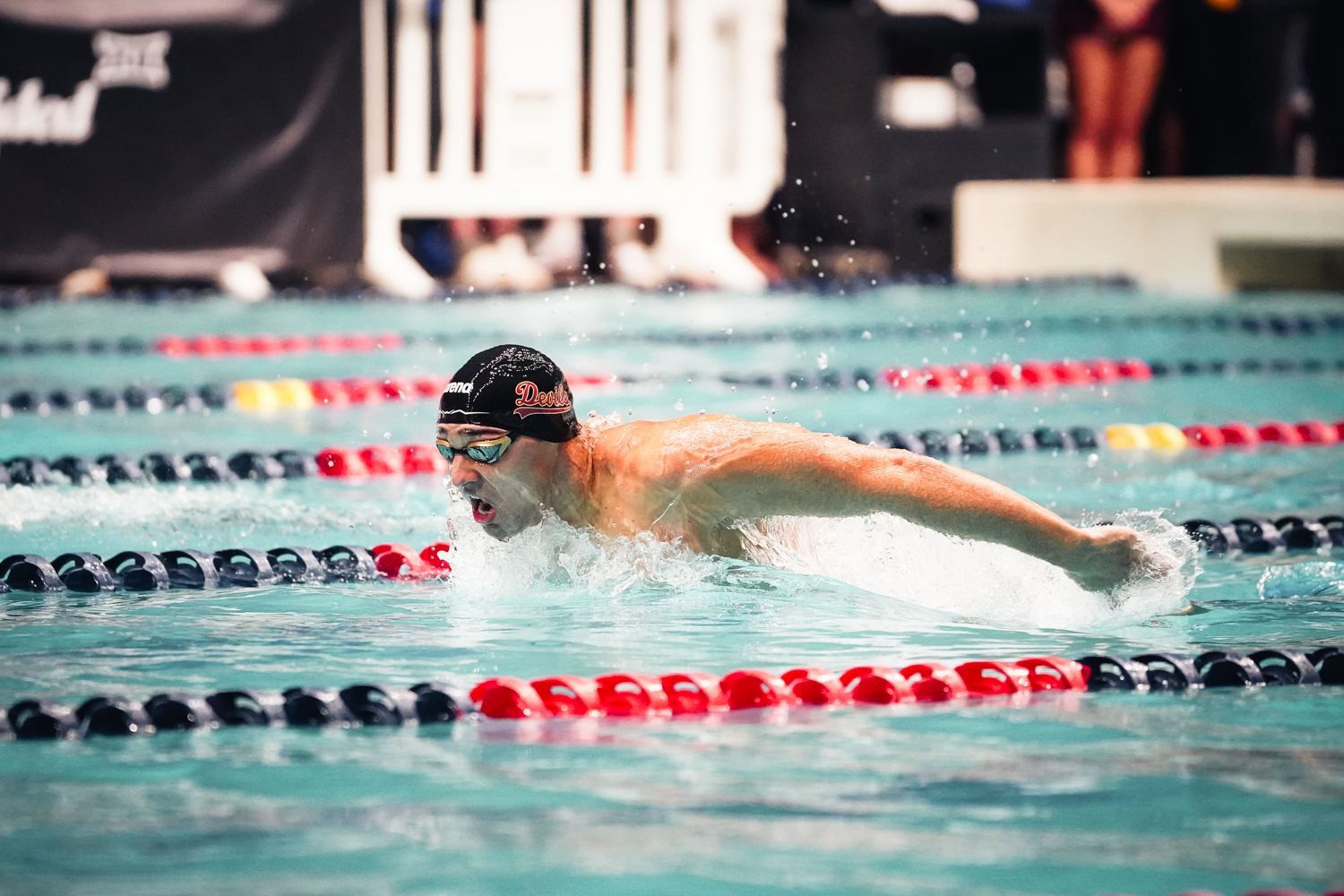
(Photo: Casey McNulty/Sun Devil Athletics)
Arizona State’s and California’s men’s teams are arguably some of the most fiery teams this season. The Sun Devils, the reigning national champions, and the Golden Bears, the national championship runner-ups from last year, are destined to fight for their chance at a championship title at the end of March.
This isn’t the first time the Sun Devils and the Golden Bears have seen each other’s faces this season. Arizona State won over Cal when it was ranked No. 1 earlier in the season. However, Cal was not at full strength and was missing most of its current roster.
In 2024, the Golden Bears were in a very different position. The team consisted of graduates Liam Bell and Colby Mefford, who were considerable assets to Cal’s NCAA performance. The Golden Bears were lucky enough to get returning fifth-years Destin Lasco, Dare Rose, Bjorn Seeliger and Matthew Jensen back for their 2025 NCAA appearance. Lasco scored 54 points at NCAAs last season and was a part of four relays, while Rose scored 28.5 points and was on two relays.
Although the Golden Bears have a slightly different team, their skills and talent make up a solid No. 3 ranked team. Recently, Cal received graduate Lucas Henveaux back on the roster after he swam for the team in the 2022-2023 season. The 24-year-old Belgian Olympian was a distance swimmer for the Golden Bears, and he helped lead the team to its 2023 NCAA title.
Another new addition to the Golden Bears squad is graduate Mewen Tomac. Tomac is a 24-year-old Olympian from France who originally announced his commitment to Cal last January and planned to train with the team in August. However, Tomac never started in the fall and has only just started training with the team. A strong backstroker, Tomac will add to the long list of the Golden Bear backstroke strengths.
The Golden Bears were not the only ones with impactful losses from last season. The Sun Devils lost French Olympian Léon Marchand this year, one of the world’s fastest swimmers. Marchand scored a colossal 60 points at last year’s NCAAs and was on four Sun Devil relays. Current Texas junior Hubert Kos was another standout swimmer for the Devils, scoring 48 points and swimming in two relays. Kos transferred to Texas after former ASU head coach Bob Bowman took control of the Longhorns’ swim program. Kos won the 200-meter backstroke at the 2024 Paris Olympics and was also the Devils’ top backstroker.
Along with those two swimmers, the Sun Devils lost multiple other big names from their national championship team. Junior Owen McDonald transferred to Indiana University after the championship win. McDonald had a second-place finish in the 200-yard medley at NCAAs and scored 46 points for the team. The junior was also a powerful backstroker for the Sun Devils. ASU also lost redshirt senior David Schlicht, who placed second in the 400-yard medley at NCAAs and scored 44 points for the Devils.
However, Arizona State is not out of the championship title race. The Devils still have sophomore Ilya Kharun, a 2024 Paris Olympian who was essential to the national championship run. Kharun is one of the fastest butterfly swimmers in the nation and holds the second-fastest time in the country in the 200-yard butterfly and the fourth-fastest time in the 100-yard butterfly. Junior Jonny Kulow intimidates the sprint freestyle field, having the seventh-fastest time in the 50-yard freestyle in the nation as well as the fifth-fastest time in the 100-yard freestyle.
The Golden Bears lack sprint freestyle abilities and have fewer strong swimmers in those events. The team’s best sprinter, senior Jack Alexy, is over a second slower than Kharun and Kulow in the 50- and 100-yard freestyle. This could be where the Sun Devils could make up some points and have an edge over the Golden Bears.
Nevertheless, the Sun Devils do not have as strong of a backstroke department as the Golden Bears. Senior Gabriel Jett has the seventh-fastest 100-yard backstroke time nationally and the fourth-fastest 200-yard backstroke time. Staying in the top ten, senior Evan Petty swims the 10th-fastest time in the 100-yard backstroke, and graduate Destin Lasco holds the seventh-fastest time in the nation in the 200-yard backstroke.
To have an extra edge over the Golden Bears, the Sun Devils will have to take advantage of their relay strengths. ASU has the third-fastest time in the nation in the 200-yard freestyle relay, and Cal is further behind in eighth. The two teams are neck and neck in the 400-yard freestyle relay, with ASU being third-ranked and Cal fourth. In the 200-yard medley relay, the Sun Devils are ahead of the Golden Bears again, with the Devils at fourth while Cal sits at sixth.
Generally, both teams are powerful in their unique ways. The Sun Devils will have advantages in the relay and sprint freestyle events, while the Golden Bears plan to score in the backstroke and medley events. Ultimately, both teams will use their strengths to their full capacities regarding points and placing at NCAAs.

