
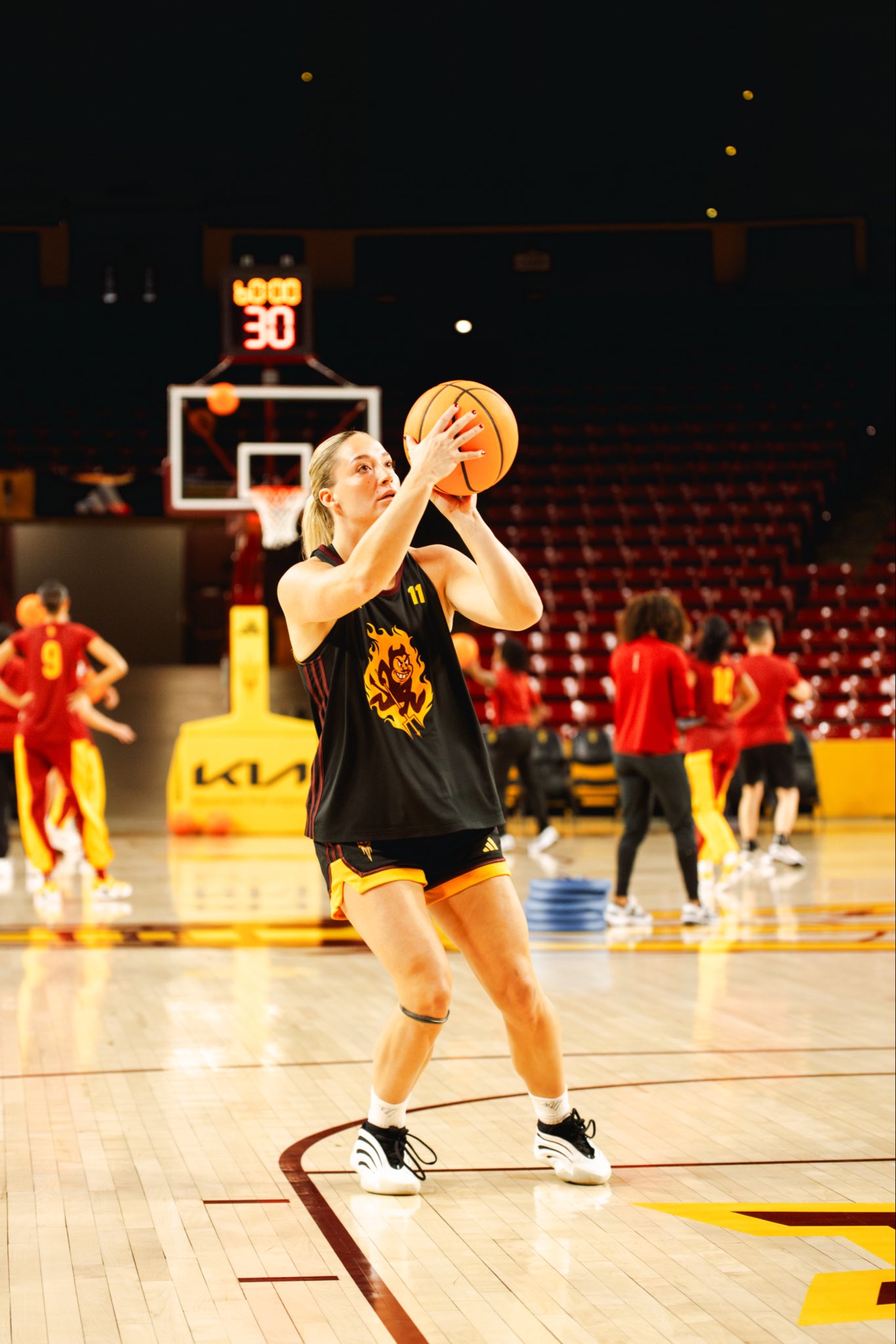
Photo: Sun Devil Athletics
Christian Jarmark also contributed to this article.
In head coach Molly Miller’s first season at ASU, her roster consists of 13 players with nine guards and four forwards/centers. Looking at it from a retention perspective, she kept that same ratio, bringing back four players and having nine newcomers, whether that be transfers or freshmen.
Guards
For the guard positions on this team, Miller attacked the portal heavily, bringing in seven transfers to only two returning players. The portal players will have to hit immediately in order for ASU to compete at a high level.
The biggest transfer of note is senior guard Gabby Elliot from Penn State, who is entering her fourth school in six years of college hoops.
She appeared in 29 games for the Lady Lions, averaging 29.2 mpg, 13.6 ppg, and 4.6 rpg on 47.4% from the field and 42.3% from three. She will be a plug-and-play starter for Miller and someone whom the Sun Devils will rely on heavily to score.
The Michigan native was also noted as having a standout performance during the Sun Devils “secret scrimmage” upset win over preseason No. 18 USC. She has been successful anywhere she goes, most prominently at Clemson for her first two years, where she was named to the ACC All-Freshman Team.
Another two high-powered scoring guards are senior Jordan Jones and senior Accacia Hayes, both of whom averaged double-digit points at the mid-major level. These two will have to hope their scoring prowess translates from the mid-major to the power conference level.
Jones transferred in from Denver, where she was she was almost immediately a starter when she got on campus and never looked back, starting 72 of her 79 games there. Last season, she averaged just under 20 points a night at 19.9 ppg. Paired along with 35.4 mpg, 6.7 rpg, and 2.9 apg.
Her scoring numbers took a huge boost from one year to the next, where she averaged 14.9 ppg in 32.5 mpg in 2023-24 and then jumped to the previously mentioned 19.9 ppg in 35.4 mpg in 2024-25. What is also of note is that her overall field goal percentage also stayed about the same last year, going from 39.6% two years ago, jumping to 40.2% last year.
Hayes has also been a starter most of her career, where in her first three years at Western Kentucky, she started 75 games. Her stat line last year read 11.3 ppg, 2.3 rpg, and 1.7 apg. She is coming off the back of what is most likely her worst statistical season.
She averaged almost a full three points less than the year prior at 11.3 ppg in 2024-25 compared to 14.0 ppg in 2023-24, with only a slightly better field goal percentage and no significant jump in rebounds or assists.
The biggest concern with either of these players that immediately jumps off the page is their lack of three-point shooting. Both have gotten steadily worse as their three-point shot attempts increase, with Jones going from a 31.0% three-point percentage her freshman year down to 25.4% by the end of last year. Hayes had a very similar percentage drop, going from 35.4% to 29.1% in that same time span.
The next two guard transfers to mention are senior and former national champion Last-Tear Poa, along with senior Marley Washenitz.
Like Hayes, one could argue that the LSU transfer Poa is coming off her worst season as a collegiate athlete, only averaging 2.0 ppg and 1.9 apg. She saw a significant minutes decrease going from 20.1 mpg the previous year down to 12.9 mpg last year. It will be interesting to see where she fits into Miller’s system with her championship experience.
Washenitz, on the other hand, has consistently improved year over year, averaging 9.3 ppg, 2.3 rpg, and 2.7 apg in 28.8 minutes a night last season for Pittsburgh. Last year was the season she took the significant jump in scoring, going from 4.1 ppg her sophomore year to aforementioned 9.3 ppg her junior year.
Along with Jones and Hayes, Poa also struggles to shoot the ball from the three-point line. She is yet another Sun Devil transfer portal addition who has seen a three-point shooting percentage decrease every since freshman year, with last year hitting rock bottom at 22.7%.
Washenwitz is an interesting case because until last season she struggled severely from three, shoting 12.0% on about one attempt per game her sophomore year, but all of a sudden, with more freedom to shoot the ball, she jumped all the way up to an even 35.0% last season.
The final transfer guard Miller acquired this portal cycle is redshirt junior guard/forward Deborah Davenport, who was a JUCO All-American last season, averaging 9.3 ppg, 8.6 rpg, 1.8 apg, along with over a steal and block a game. She is listed as a forward due to her prowess on the boards, which will help the Sun Devils tremendously, who are thin in the frontcourt.
Junior guard Jyah Lovett is the biggest retention of the bunch, as she played in 31 of the 32 games for ASU last year, tallying 28.2 minutes per game, while averaging 8.9 points per game, 2.6 rebounds per game, and 2.0 assists per game on 41.6% shooting from the field.
Lovett will compete for one of the starting guard spots this winter, but with a new coach bringing in her own players and transfers, there are no guarantees. If she wants to do so, she will have to step up her facilitation game with her measly two assists in almost 30 minutes a night.
Senior guard Makayla Moore also returns. Moore appeared in 21 games for the Sun Devils, averaging 20.9 mpg, 3.5 ppg, and 3.1 rpg on 35.1% from the field. Moore struggles to get to the line only averaging 0.1 free throw attempts per game. She will need to be more aggressive this upcoming season.
What bodes well for these two is their ability to shoot the three-pointer compared to the rest of the field. Despite a smaller sample size, Lovett and Moore shot the three at 41.3% and 35.4%, respectively, last season.
All nine of these players have an argument for some form of playing time this upcoming season. It will be interesting to see how coach Miller deploys the different skillsets with each other and who she will end up trusting with the ball in their hands as the year progresses.
Forwards/Centers
While ASU’s guard depth doesn’t seem to be an issue, the Sun Devils are thin up front. With just four designated forwards and centers, the lack of size and experience could pose problems against bigger teams. In 2024, graduate center Nevaeh Parkinson was third on the team in scoring at 9.7 points per game and second in rebounds with 6.4, while junior forward Kennedy Basham, who left for TCU, led the team on the glass with 6.5 boards.
ASU’s frontcourt is a question mark heading into the season, primarily because of its youth. Of the four women, only junior forward McKinna Brackens has played a full season as a starter. Redshirt freshman center Timya Grice missed the entire 2024 season due to injury, and the other listed center, Martina Fantini, is an incoming freshman from Italy. Sophomore forward Heloisa Carrera spent one year at Ole Miss before transferring to ASU, but had limited playing time during her opening campaign, averaging just five minutes a game across 13 contests.
Brackens figures to play a pivotal role for the Sun Devils compared to what she did over the past two years, especially given the lack of other options. The UNLV transfer significantly ramped up her scoring during her sophomore season, averaging 9.8 points and 5.7 rebounds per game on 44.5% shooting from the field.
Her ability to put the ball in the bucket down the stretch from the post or through cuts was also valuable; Brackens had a game-winning layup against Wyoming from the dunkers spot in mid-January and a go-ahead bank shot in an iso situation with under a minute to play against San Diego State less than a week later. With the amount of ball handlers that ASU has on offer, Brackens’ point-forward skills likely won’t be required but she’s a willing passer who could potentially open up the offense through different actions inside the arc.
Beyond Brackens, it’s tough to come to any conclusions about the rest of the Sun Devil bigs who remain largely untested. There’s clear potential for growth that breeds optimism but limited opportunities on the court could make it a challenge to bring them up to the speed and physicality at the college level. Grice’s time around the team and her familiarity with the program give her an immediate pathway to starting, and her 6-foot-5-inch build provides her with a built-in advantage.
The Texas native has a lanky frame that can block or alter attempts around the rim and snatch missed shots off the glass, but she’ll likely have a restricted role in her first year of college play. Grice mostly operates around the basket, leaving her vulnerable to pull-up jump shooters or quicker forwards and centers that can effectively space the floor, which is where Fantini could make her mark.
Unlike the physically imposing Grice, Fantini’s European background gives her a fundamental base that she operates off of on both sides of the court. Offensively, the Italian possesses solid footwork and touch for a freshman big, displaying drop-steps and decisive motions from initial entry passes. In just 12 minutes per game at the U20 Women’s FIBA Eurobasket, Fantini averaged seven points on 56% shooting. Her 76.9% mark from the charity stripe also points towards the prospect of her extending her range out to the three-point line in the future.
Carrera’s tasks figure to be complementary to the rest of the starters, depending on how Miller feels about the starting lineup. Certain matchups could end up with her seeing minutes if ASU needs her size on the boards.
Defense was Miller’s calling card when she was at GCU, and that mentality holds up in her first year in Tempe. The Antelopes were fifth in the nation in steals per game, ninth in turnovers forced, and 15th in turnover differential in 2024 behind Miller’s aggressive defensive scheme that she’s referred to as “organized chaos”, putting an emphasis on trapping the ball and creating opportunities as a team. Based on her coaching pedigree and results, the interior defense would definitely benefit from a stauncher perimeter unit, while growing in their positions themselves.
Miller’s introduction to the women’s basketball program is the biggest story surrounding the team this year, but it’s how she deploys the pieces handed to her this season that will end up defining this season for the Sun Devils.

