
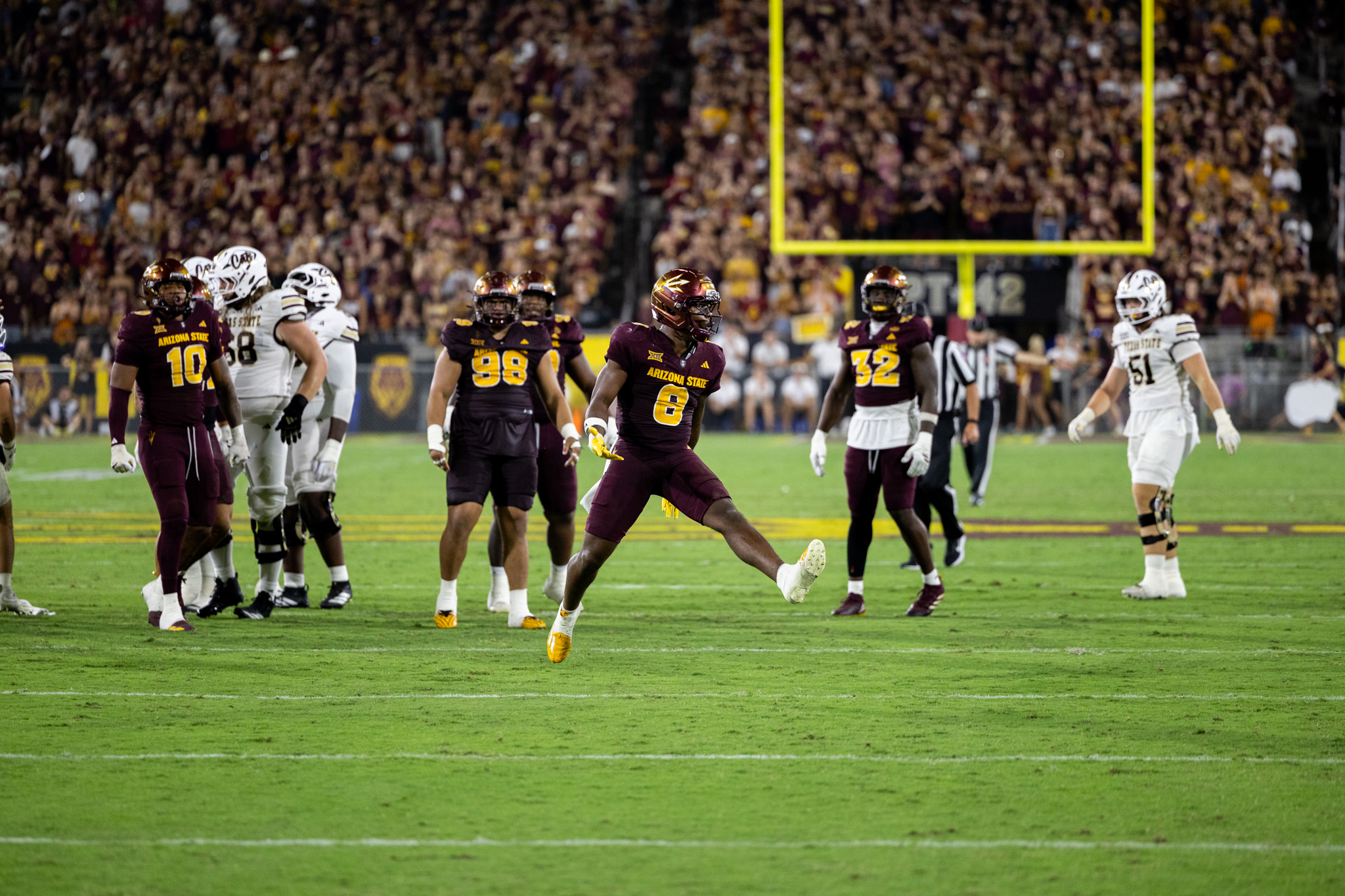
(Photo: Madison Sorenson/ WCSN)
TEMPE – Before the 2025 season even began, head coach Kenny Dillingham outlined his expectations for Arizona State football to improve in one key department — explosive plays. Whether those plays came from gaining more than 25 yards on a single offensive play or the defense forcing negative actions for opponents such as sacks or forced fumbles, Dillingham envisioned ASU as a more dynamic team.
Across the first two weeks of the season, the Sun Devils fell short of that expectation. Offensively, ASU left much to be desired in the explosive plays realm — first with a subpar showing against Northern Arizona, then with a lackluster performance against Mississippi State. Defensively, the Sun Devils didn’t allow many big plays, but they weren’t generating many negative ones either.
On Saturday night, Dillingham’s vision finally came to fruition. ASU’s offense produced multiple big plays both on the ground and through the air. On defense, the Sun Devils lived in the backfield and wreaked havoc on Texas State’s offense. Ultimately, the high-impact plays on both sides of the ball were what propelled ASU (2-1) to victory over the Bobcats (2-1).
“Good offense is scoring points. Good defense is not letting them score points,” Dillingham said. “Yards are not really relevant to me. It just doesn’t matter.”
On offense, most of the Sun Devils’ chunk plays came on the ground — and that’s what ASU’s offense leaned on throughout the game. Of the Sun Devils’ 67 total plays, 38 of them were designed rushes. Of ASU’s 245 team rushing yards, 200 were accumulated through 10 rushes that went for 10 or more yards.
The largest Sun Devil rush of the night came in the third quarter with around two and a half minutes left. Texas State sent a nickel blitz from the right side of the field. Redshirt junior running back Raleek Brown ran to the left and hit the hole ASU’s offensive line created for him. Once he got past the sticks, Brown hit second gear and dashed into the endzone for a 75-yard touchdown.
“I’ve been working for two years or a year and a half. Been working a lot,” Brown said. “It felt good to have a long run.”
Through the air, the Sun Devils finally got the kind of performance they’d been waiting for from redshirt sophomore quarterback Sam Leavitt. Leavitt finished the night with 263 total yards – 188 passing and 75 rushing. Like ASU’s offense, most of Leavitt’s highlights were on the ground.
Over the first two games of the season, Leavitt raised questions about his NFL draft stock among pundits across the country. Concerns surfaced after NAU and intensified following last week’s loss to Mississippi State — a game in which Leavitt averaged just 3.28 yards per dropback.
Of Leavitt’s 15 completions on the night, four went for over 15 yards. Of these four, two of them were one-play touchdowns. The first was a 30-yard off-platform completion to redshirt junior wide receiver Jordyn Tyson – who created separation on a slant route then added 15 yards after the catch into the endzone. The other was a 27-yard screen pass to redshirt senior tight end Chamon Metayer – who caught a career-high six passes.
“Passing 188 on 15, that’s pretty good. It’s over 10 yards. And then rushing, his ability to extend in the rushing game, 75 yards,” Dillingham said. “I thought he got in a rhythm. I thought he played well.”
When the Sun Devils were on defense, big-time plays came in bunches. The biggest play of the night came from junior corner Keith Abney II with 12 minutes left in the second quarter. It looked like junior receiver Beau Sparks picked up a first down for the Bobcats on third-and-four, until Abney stripped away the ball and forced the turnover for ASU.
The Sun Devils made life rough for redshirt freshman quarterback Brad Jackson. In total, ASU’s defense racked up 10 tackles for loss, five sacks, and four QB hits. At the forefront of the Sun Devils’ dominant defensive performance was senior linebacker Jordan Crook – who led the team with 12 tackles and 3.5 tackles for loss along with picking up a sack.
“We just wanted to make sure we went out there and played our style of football,” Crook said. “We wanted to make sure we stayed on their neck the whole game.”
ASU primarily runs cover 3 on defense, a zone coverage scheme designed to prevent explosive plays. Knowing this, Dillingham was especially pleased to see the defense not allow a single pass of at least 20 yards. In contrast, ASU’s offense connected on three passes of more than 20 yards — a sign of explosive play progress on both sides.
“Cover 3 is not built to give up explosives,” Dillingham said. “It’s built to force a team to be efficient down the field.”

