
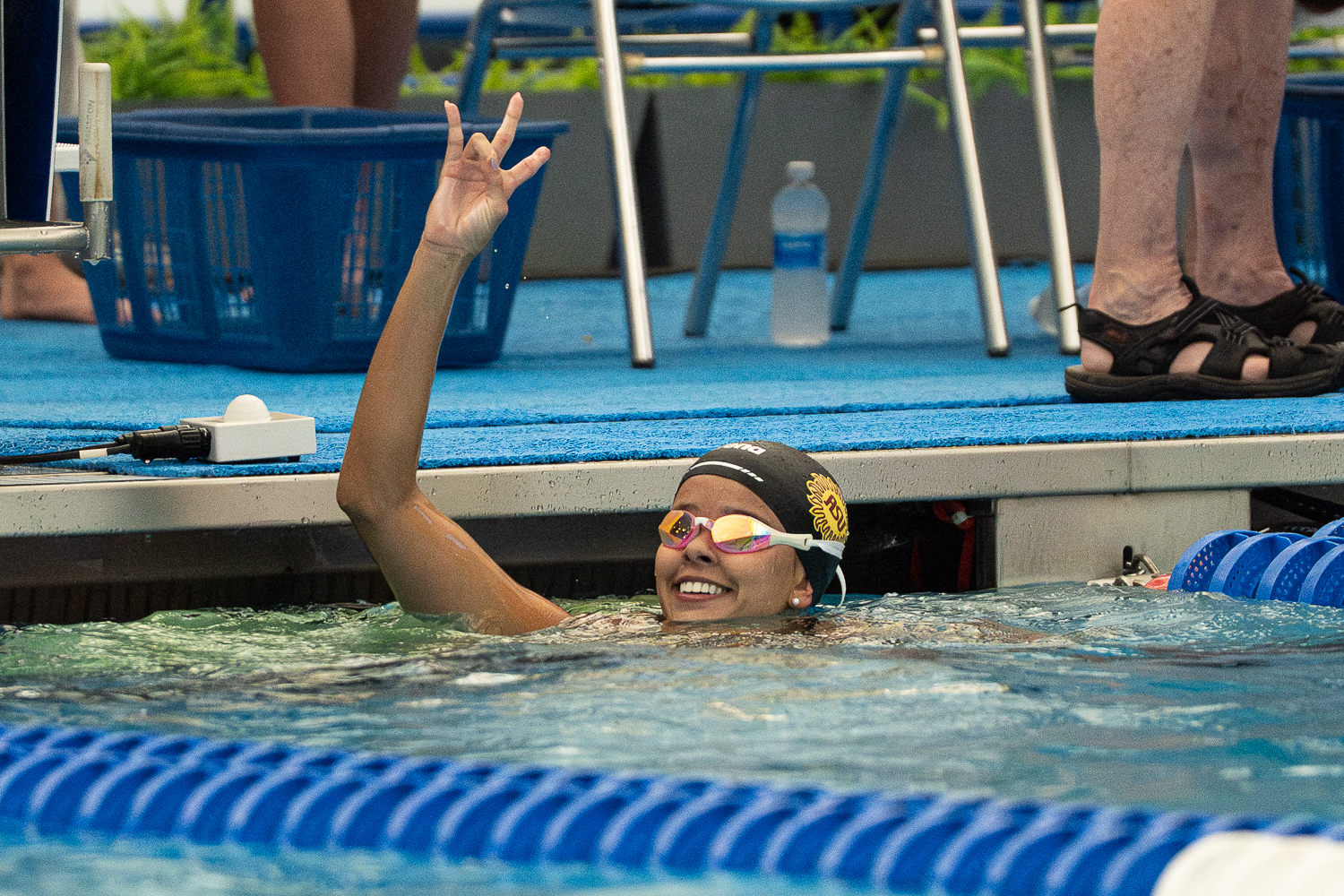
(Photo: Casey McNulty/Sun Devil Athletics)
On rainy days in Boca Raton, Florida, when lightning warnings are nearby and the conditions are too harsh for swimming, St. Andrew’s School swimming head coach Stephen Cassidy and his staff will show a TED Talk to their team.
“We’ll say, ‘Hey, listen, here’s one of our graduates. You think you’re having a tough time, or you have a tough way? Follow this.’” Cassidy said. “And it resonates with them.”
The TED Talk video features a 2025 speech in which Arizona State freshman swimmer Alexia Sotomayor discusses overcoming an obstacle in the competitive world of swimming.
“I literally can’t see half of what’s happening,” Sotomayor said in the TED Talk. “I was born with unilateral vision. I can only see out of one eye.”
Unilateral vision has left Sotomayor without depth perception and peripheral vision in her left eye, but she hasn’t let her condition stop her from jumping into the pool every day as a competitive swimmer with a drive like no other, becoming an inspirational figure in the process.
Sotomayor specializes in backstroke sprinting events: the 50-, 100- and 200-yard races. She also competes in the butterfly and as a backstroke swimmer in medley relay races.
“I can’t really explain what I can see or I can’t because it’s been like that my entire life,” Sotomayor said. “I was born with this condition, and it’s just the way I grew up.”
At 15 years old, Sotomayor left her home in Lima, Peru, to attend St. Andrew’s and swim under coach Cassidy.
Sotomayor was considered to be one of the top up-and-coming swimmers in Peru before making the move. At 12, she was one of the youngest swimmers competing at the 2019 Junior Pan American Games in Chile, where she won the 100-meter backstroke with a time of 1:05.16. Performances like that, as well as her energy, intensity, drive and confidence drew Cassidy to Sotomayor.
Sotomayor faced more challenges in Boca Raton. She had to overcome a language barrier, acclimate herself to a new environment and a completely different training routine that she was unfamiliar with.
“She learned about team swimming,” Cassidy said. “She really became very adept at relay splits and doing things that way … I think it was a great kind of dress rehearsal.
“She told me early on in her training career (about her condition), because we were talking about the backstroke turns, and I realized her depth perception was not the same without two eyes, but she adjusted so well. She never complained about it.”
Sotomayor’s low vision has required her to adapt, but not change her training routine at practices or how she attacks meets.
Through her experiences, Sotomayor has developed a level of tenacity that she displayed when she competed in the 2021 Junior Pan American Games in Cali, Colombia.
At the beginning of her race, she dislocated her knee. Pushing through the pain, she continued to swim, finishing the race.
The injury was a setback for Sotomayor in her pursuit to represent Peru in the 2024 Summer Olympics in Paris. She described the loss in her TED Talk as “losing everything.”
“She was pushing herself, in my opinion, so hard, just for that special Olympics,” Cassidy said. “I’m like, ‘Look, you’re not judging a human being based on whether you make the Olympic team, or whether you break a national record,’ and I think that the resolution of that was her stepping to another level, and I think it really helped her in her growth overall.”
ASU has become renowned as a factory for swimmers. When Sotomayor was reaching out to colleges, ASU’s head coach was Bob Bowman, who coached the most decorated swimmer in Olympic history, Michael Phelps.
Bowman led the Sun Devils to their first national championship in 2024, but left the program for Texas afterward, elevating associate head coach Herbie Behm into the front-and-center role. Despite the change, Sotomayor was still intrigued when Behm showed interest in her skills. She wanted to be part of the established success.
“She was the first one committed over two years ago, and she’s been so excited about what we’re doing and how we’re doing it,” Behm said. “Having her here, she’s been great, swimming really fast, but in and out of the pool doing everything we could ask.”
When Sotomayor first arrived at ASU, the Mona Plummer Aquatic Center, the team’s home, presented another obstacle for her. The facility is outdoors, giving a backstroker no reference point when they’re swimming.
For Sotomayor, it was a welcoming challenge to hone her skills as an elite swimmer.
“Swimming backstroke outside is a little harder because it’s off-centered,” Sotomayor said. “But I’ve managed to do it. I have to focus additionally on my technique, which is what every elite swimmer wants to have: A really good technique. Having that helps and makes it easier to swim in a straight line.”
Before her TED Talk, Sotomayor rarely shared her condition with others. In the past, she never spoke about the surgeries she had during her childhood or the questioning looks people gave her. Now, she’s found that sharing her story is something that can help others overcome obstacles.
“Outside of the water, the TED Talk, I think that’s one of the biggest impacts I probably have made,” Sotomayor said. “Opening up the struggles, not everyone can do it, and some people probably never will, but sharing a little bit of my story can help some others learn and grow from whatever they’re dealing with.”
Sotomayor didn’t plan to be an inspirational figure in the swimming community, but that’s what she’s become.
“I had a couple of the middle school girls that saw it this year, when I showed it to them, they were absolutely amazed,” Cassidy said. “They were like, ‘Oh, my God, coach, we saw her swim. We never realized. We didn’t know.’ They were very mesmerized and inspired.”
Sotomayor has room to grow, but she’s already overcome so much to have a spectacular freshman campaign. She took home Big 12 Newcomer of the Week honors for the week of Oct. 9, and finished inside the top-10 in multiple events at the Big 12 Swim and Dive Championships.
“She’s already made like 10 different best times this year, she’s already dropped a lot of time and she still has so much development to have,” Behm said. “On the strength side, she has so much to grow, and you can already see her making pretty major improvements.”
The steady improvements and accomplishments for Sotomayor have invigorated her, but maintaining her standards as a teammate has been her utmost priority. With the Olympics coming to Los Angeles in two years, Sotomayor has the desire and determination to make the team and represent her home country.
She knows the feat won’t be easy, but her message of resilience and endurance motivates her to achieve the dream she’s held for so long. While others wish for things they could change in their lives, Sotomayor embraces everything life has given her and insists it makes her stronger.
“If there was any way medically in some future that I could be able to gain vision, I don’t think it’s possible, but if there was, I don’t think I would change it,” Sotomayor said. “Accepting that’s who I am, something that I used to hate or hide is now something that I openly talk about and just keep growing from.”

